

The Big Picture
Fiserv's FI 0.00%↑ stock dropped after Q1 earnings revealed Clover volume growth slowed from 14% to 8%. Shares fell further on May 15 when the CFO indicated Q2 Clover volume growth would match Q1.
“Fast forward to today, right now, and I don't give quarterly guidance period, let alone on one key performance indicator around Clover. But given the lots of discussion and questions around it, we expect second quarter to be generally similar to first quarter in terms of the reported growth rate from a volume standpoint.”
Robert Hau, CFO of Fiserv at the J.P. Morgan Technology Conference on May 15
My view I shared on X on May 15:
I believe Fiserv $FI faces a growing credibility issue. The #Clover slowdown - unsurprising to them but unexpected by the market - was attributed to Easter timing, leap day, and weakness in Canada, suggesting a Q2 improvement that now seems unlikely.
Fiserv is down nearly one-third since its February peak, despite unchanged EPS estimates. The stock now trades at 15.8x 2025 consensus EPS of $10.22, down from over 23x. I bought shares after earnings and on May 15.
My analysis suggests that, under a conservative approach, Fiserv's fair value exceeds $185 per share. A more realistic set of assumptions yields a valuation well north of $200 per share. At $161 per share, an acceptable margin of safety exists, making Fiserv shares attractive.
A Brief Word on Valuation
Valuing stocks is challenging. Two common methods are applying a multiple to earnings or using a discounted cash flow (DCF) model. Earnings can be manipulated, and their definition varies by company. The DCF model rightly values a company based on future free cash flow discounted to the present but relies on subjective assumptions. Combining both—using a DCF model cross-referenced with market-based valuation multiples—is often best. A company attractive under both approaches is likely a strong investment.
My Approach
I build earnings-based and discounted cash flow models, adhering to these rules:
First, I use my own earnings calculations, not the company’s. I never add back stock-based compensation or recurring acquisition and restructuring charges.
Second, I model the company based on the assets they have, avoiding predictions about future transactions, even if the company has a history of accretive acquisitions.
Third, I adopt conservative assumptions, expecting outperformance to revert to the mean and underperformance to persist.
The DCF model is highly sensitive to the discount rate and terminal growth rate.
I typically use a 10% discount rate, adjusted higher or lower based on earnings stability and management’s capital allocation practices. For example, I use a lower rate for Paychex PAYX 0.00%↑ due to its predictable business model and 80% dividend payout ratio.
For the terminal growth rate, I use a nominal rate reflecting expected inflation and real GDP growth.
I apply a 10-year forecast period, assuming lower growth and margin expansion in later years.
To account for dilution from equity compensation, I subtract stock-based compensation from free cash flow before discounting.
Fiserv: My Conservative Scenario
Key Assumptions
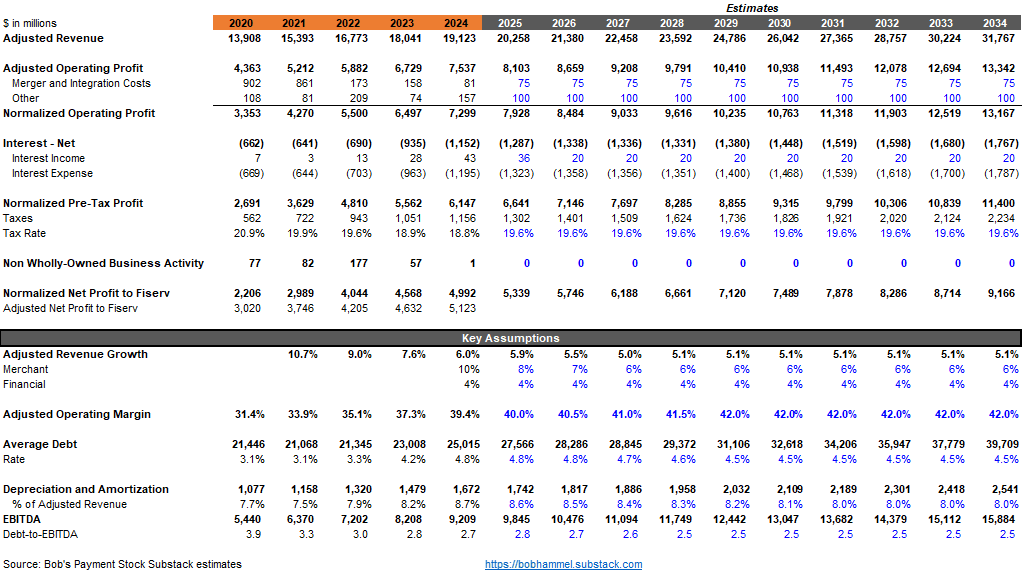
For 2025, adjusted revenue growth of under 6%, with 8% Merchant growth and a 4% increase for Financial Solutions. 60 bps of adjusted operating margin expansion to 40%. Fiserv guides 8.5-10.5% adjusted revenue growth, excluding acquisitions, and margin expansion over 125 bps.
Adjusted revenue growth slows to 5% in 2027, remaining steady thereafter. Similarly, I project the adjusted operating margin reaches 42% in 2029, then stabilizes.
Merger, acquisition, and other costs reducing Fiserv’s adjusted operating profit by $175 million annually.
A tax rate of 19.6%, slightly above the past two years, reflecting the five-year average.
Fiserv’s debt-to-EBITDA ratio falling to 2.5x by 2028, with the average debt interest rate dropping to 4.5% from 4.8% in 2024.
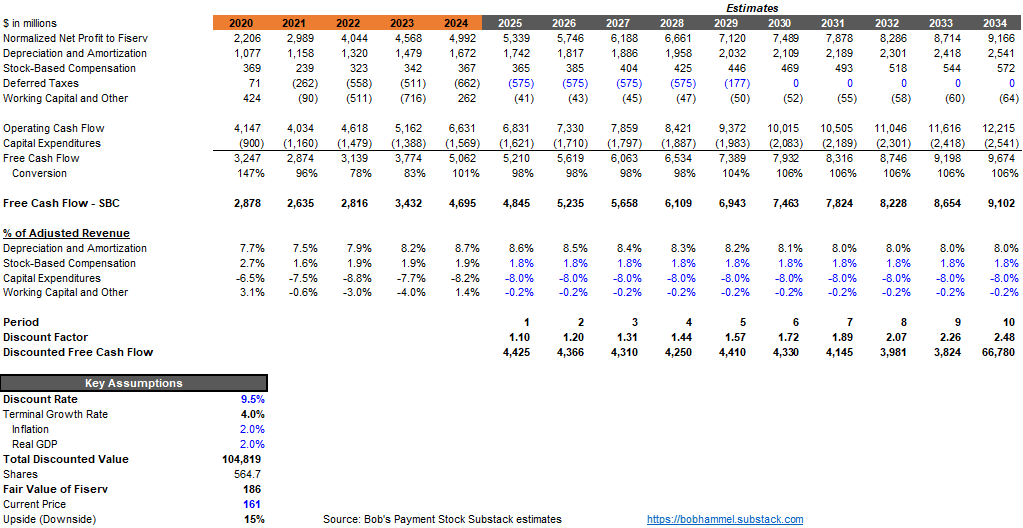
Fiserv’s deferred tax liability of $2,477 million is exhausted over six years.
Stock-based compensation averages 1.8% of adjusted revenue.
Capital expenditures are 8% of adjusted revenue during the forecast period.
Depreciation and amortization, and capital expenditures equal 8% of adjusted revenue in 2034.
A 9.5% discount rate and a 4% terminal growth rate.
A total discounted value of $104.8 billion, implying $186 per Fiserv share.
Fiserv: My More Realistic Scenario
Key Assumptions
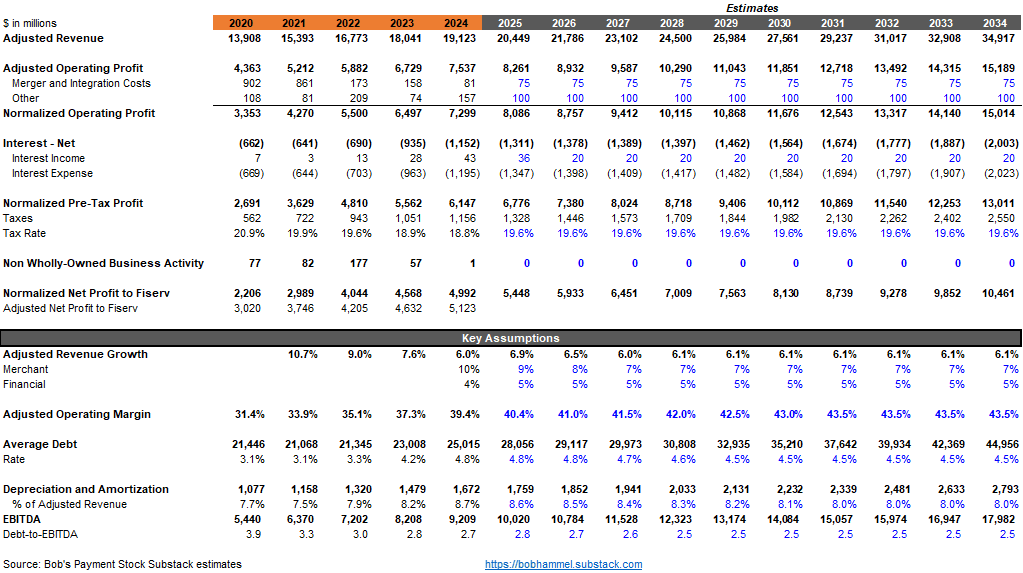
For 2025, adjusted revenue growth of about 7%, with 9% Merchant growth and a 5% increase for Financial Solutions. 100 bps of adjusted operating margin expansion to 40.4%. Still below Fiserv’s guide of 8.5-10.5% adjusted revenue growth and margin expansion over 125 bps.
Adjusted revenue growth slows to 6% in 2027, remaining steady thereafter. Similarly, I project the adjusted operating margin reaches 43.5% in 2031, then stabilizes.
Merger, acquisition, and other costs reducing Fiserv’s adjusted operating profit by $175 million annually.
A tax rate of 19.6%, slightly above the past two years, reflecting the five-year average.
Fiserv’s debt-to-EBITDA ratio falling to 2.5x by 2028, with the average debt interest rate dropping to 4.5% from 4.8% in 2024.
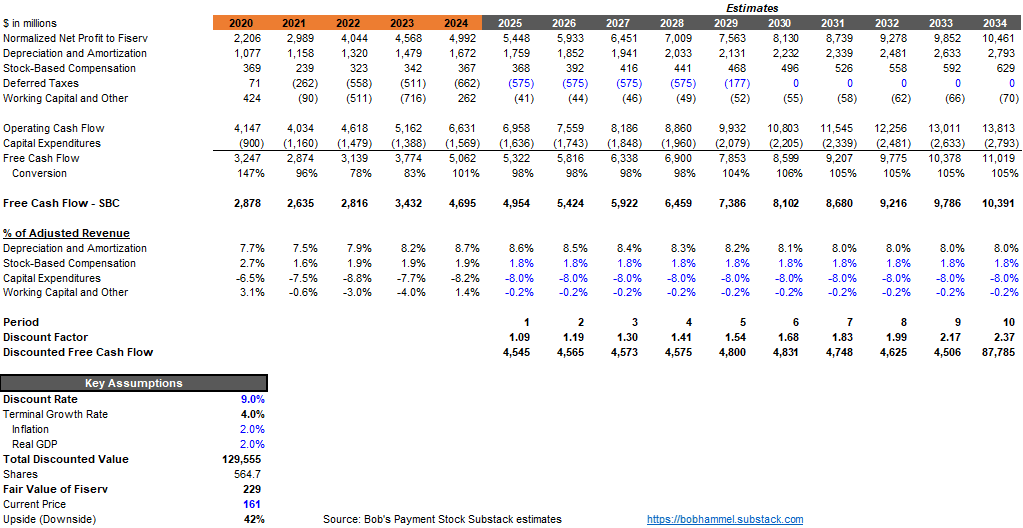
Fiserv’s deferred tax liability of $2,477 million is exhausted over six years.
Stock-based compensation averages 1.8% of adjusted revenue.
Capital expenditures are 8% of adjusted revenue during the forecast period.
Depreciation and amortization, and capital expenditures equal 8% of adjusted revenue in 2034.
A 9% discount rate and 4% terminal growth rate are appropriate for Fiserv, given its recurring core account processing business, secular growth in the Merchant business, and management's consistent use of free cash flow for share repurchases.
A total discounted value of $129.6 billion, implying $229 per Fiserv share.
Market-Based Valuation Multiples
In my conservative scenario, Fiserv’s implied fair value of $186 suggests a multiple of slightly over 18x 2025 consensus EPS of $10.22, just above its 10-year 25th percentile value of 17.1x. It also represents a significant discount to the S&P 500, trading at about 22.5x consensus EPS of $258.
Using the more realistic approach, Fiserv’s fair value of $229 implies a multiple of 22.4x 2025 consensus EPS of $10.22, compared to its 10-year 50th percentile value of 21.5x. It would also suggest a multiple in-line with the S&P 500.
Disclosure: I am long Fiserv and Paychex. The article is for informational purposes only and is not a recommendation to buy or sell Fiserv, Paychex, or any other stock.
Thanks for this! In your valuation you have debt rising with EBITDA and rising interest expense. But do you give any credit to FCFE to this growing debt (the majority of which will likely be deployed into share repurchases i.e. more cash flow available to be distributed to shareholders)?
Good analysis of the different scenarios. Question I've been asking myself is what causes the market to re-rate the stock? It seems to have been a darling of investors for a while and once that pops it requires some reacceleration in Clover or some other catalyst to get it moving in the right direction.