
Global Payments: Nothing Comes Easy
Sustained Middle East conflict dents 2026 outlook, but path to 2027 acceleration looks intact and open

Synopsis: Due to sustained conflict in Iran and the broader Middle East (ME), which is impacting air travel and payment volume for some of Global Payment’s (GPN) customers (they serve the 12 largest airlines in the ME), GPN decided to temper its full-year outlook, framing it as de-risking H2 guidance to assume the Q2 ME headwind (100-bps to organic revenue growth) persists for the remainder of the year. As a result, they now expect organic revenue growth of 4-5% for the full year versus approximately 5% previously, with the cadence being 4.5% (Q1), 4.0% (Q2) and about 4.5% for H2. Adjusting for the ME conflict yields 4.5% (Q1), 5% (Q2) and 5.5% (H2), implying underlying acceleration, albeit modest. Additionally, GPN lowered the midpoint of its EPS guidance by 1.5% ($0.20) to account for the lower revenue guidance AND a less favorable FX outlook due to recent dollar strengthening. Despite the guidance reduction, shares fell less than 1%, preserving the stock’s recent gains (up more than 40% since June 10 bottom), suggesting the market may be looking past 2026, toward 2027 and a path for revenue growth to accelerate. The purpose of this update is to review Q2 results and new segment disclosures, walk through my organic revenue outlook for 2027, and list GPN’s key objectives for the next 18 months.
Q2 2026 Results

Pro-forma non-GAAP net revenue of $3.159 billion increased 1.5% on a reported basis with a slightly more than 2% ($65M) headwind from dispositions, which, to the best of my knowledge, consists solely of the Payroll business sale completed last October. According to GPN, normalized growth was 4% versus my calculation of 3.6-3.7% (potential rounding). The FX impact was largely neutral. The ME conflict had an approximately 1-point impact with a smaller impact (perhaps 30-bps) from lower IRS tax payments processed.
On a pro-forma basis, GPN’s adjusted operating profit increased 3% with 50-bps of margin expansion. Adjusting for dispositions, adjusted operating margin expanded by 70-bps, suggesting the Payroll business was more profitable than the remaining business. To be fair, the disclosures here are a little confusing with declines in each segment-level margin (some significant) offset by a decline in corporate and other (-14%), which fell by 290-bps as a percentage of revenue.
EPS of $3.46, up 12%, slightly exceeding consensus of $3.44.
GPN generated $687M of adjusted FCF in Q2, representing 74% of adjusted net profit. Although an improvement from the last two quarters, acquisition and transformation-related costs excluded from the calculation remain significant ($292M, down from $1.1B and $553M during Q1 and Q4). During the quarter, GPN repurchased 8M shares for $550M implying a price of $69/share. Across share buyback and dividends, GPN continues to expect to return $2B to shareholders in 2026. FCF conversion is seasonally higher in H2. For the full year, GPN still expects to convert more than 90% of adjusted net profit to adjusted FCF, with adjustments moving down through 2027.
GPN introduced new segment disclosure post-Worldpay:
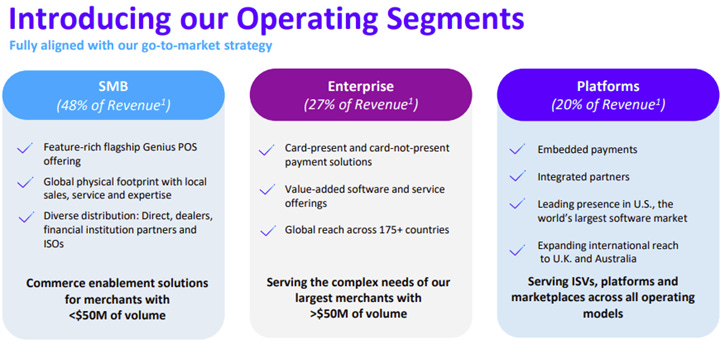
SMB represents a combination of GPN’s owned vertical software (i.e., ACTIVE, K-12/higher-ed from Heartland, property management from Zego), including its flagship Genius platform for restaurants and retail, as well as non-integrated processing solutions for merchants acquired through dealers, financial institutions, and independent sales organizations (ISOs). The company has a significant presence in the U.S., Canada (legacy GPN), and the U.K (legacy GPN and Worldpay). with other geographies including central and eastern Europe (EVO Payments), Mexico (EVO Payments) and Asia-Pacific (legacy GPN). GPN’s vertical software, including Genius, likely represents a minority of the segment but is growing faster while the other, larger portion grows at a GDP-type rate, in my opinion. In Q2, SMB revenue was flat on a reported basis, reflecting the disposition of the Payroll business. Adjusting for this, organic growth was 4%. GPN referenced stronger growth in North America, which is not surprising given the more favorable spending backdrop, with weakness in the U.K. While the company continues to tout favorable Genius statistics (bookings up 25% quarter-over-quarter and new customer yields up 75% year-over-year), the overall contribution remains modest, suggesting a meaningful impact on the segment’s performance will take some time.
Enterprise represents clients with over $50M of annual volume. Part of that is card-present (slower growing, with a significant presence in places like U.S. grocery stores) and the other, more attractive part is the global e-commerce business. Reported and organic revenue grew 7% during Q2. The ME conflict had a 4-point impact suggesting underlying growth of 11%. E-commerce revenue grew low-double digits. If we assume online airline bookings were the primary area of impact from the ME conflict, then it would suggest underlying e-commerce revenue growth was in the mid-teens.
Platforms has two components, an integrated channel and embedded payments. As the name suggests, GPN integrates payment processing into partnered software in the integrated channel. It‘s more full-service acquiring, generating higher yields for GPN. In embedded payments, GPN provides a wholesale-type processing solution to payment facilitators (software and marketplaces) that control the relationship with merchants and take more risk and provide more services. GPN generates lower yields in embedded payments. Reported and organic revenue grew 7% during Q2. According to GPN, the embedded channel represents about 20% of Platforms and is growing revenue close to 20% suggesting the integrated channel is growing MSDs or lower. As a result of this dynamic, volume growth (10% in Q2) is outpacing revenue growth (7%).
Bullish Points: (1) Excluding non-core parts of the business (partners no longer making referrals, non-core portfolios from Worldpay, and a managed services relationship for a departing portfolio), revenue growth was about 5.5% during Q2 and 6% for H1; (2) at a mid-teens growth rate, the global e-commerce appears to be performing quite well, especially given competition from Stripe, Adyen, Braintree and Checkout; and (3) GPN was firm in its belief that 2027 should see accelerating revenue growth (more on that later).
Bearish Points: (1) A stronger spending backdrop in North America was unable to offset the headwinds from the ME conflict, resulting in a slight reduction to organic revenue guidance, which is never good; and (2) GPN’s adjusted FCF number continues to be highly suspect given the level of add-backs.
2027 Organic Revenue Growth Outlook
I see a path to approximately 6% organic revenue growth during 2027 based on: (1) modest near-term underlying acceleration in Enterprise and Platforms organic revenue growth; (2) modest acceleration in SMB organic revenue growth (4% to 4.5%) starting in H2 2027 as Genius starts to become more meaningful; (3) lapping ME headwinds (a 4-point headwind to the Enterprise segment and 1-point overall) in Q2 2027; and (4) a slowing decline in non-core revenue.
Enterprise implies underlying acceleration to approximately 12% organic revenue growth by Q2 2027 from 11% in Q2 2026, largely due to business that has already been signed but has yet to convert.
Platforms acceleration of 0.5% starting in Q3 2026, reflecting an increasing mix of faster growing embedded payments revenue. I assume growth slows back to 7% by H2 2027.
I assume there will be no change in SMB organic revenue growth over the next four quarters with a modest step-up in H2 2027 due to a more meaningful contribution from Genius.
My model assumes no change in the ME, only that it’s lapped in Q2 2027. A full return of flight activity would presumably result in upside to my estimates.
I assume non-core revenue declines 19% in 2026 and low double-digits in 2027. This is my attempt at conservatism, but I admittedly do not have strong visibility into this line item.

Key Objectives
I believe GPN must do the following over the next 18 months in order for the stock to continue to move higher:
Successfully deliver on its de-risked organic revenue growth outlook for H2 2026 (4.5%)
Generate accelerating revenue growth in 2027, preferably 6% or greater
Provide more disclosure around the Genius platform, including at least volume and revenue statistics (similar to Fiserv)
Narrow the gap significantly between GAAP FCF and adjusted FCF by the end of 2027, if not sooner
Thoughts On The Stock
This was not the quarter and guide I had hoped for from GPN, but it wasn’t necessarily overly disappointing either. The ME impact had been well telegraphed after all, so it shouldn’t have taken anyone by surprise. A less than 1% decline shows it did not, and sentiment might be out of the basement for the time being. At the new midpoint of its 2026 EPS guide, GPN trades at <6.5x. I continue to believe there’s appreciable upside for the stock if GPN can deliver on its commitments, namely the ones I laid out earlier: 6% organic revenue growth in 2027 and a significant narrowing in GAAP to adjusted FCF. Of course, that’s TBD, and GPN’s track record has not necessarily been stellar. In full disclosure, I slightly trimmed my position at the open today (from 2,000 to 1,950 shares). There are two tranches of GPN stock I own: the first, and much larger portion, was acquired in the 2022-2023 time frame, with an average cost basis of around $100-110; the second, smaller portion, was acquired on the day the Worldpay acquisition was announced, below $70. I view this morning’s sale as a small unwind of that post-Worldpay acquisition buy, as my thesis that the company was (and is) not going to blow-up has largely played out. I still consider GPN a core position but would not preclude additional trims if the stock continues to move higher ahead of, or without, corresponding objectives being completed.
As always, thank you for reading, and if you’ve enjoyed this, please consider sharing, liking, commenting, or subscribing!
Disclosure: As of August 5, 2026, of the stocks mentioned in this report and across payments and fintech, I am long Visa, Global Payments, Intuit, Block, Adyen, Shift4 Payments, Paychex, Mastercard, and Broadridge Financial. This report is for informational purposes only and is not a recommendation to buy or sell any stock. Finally, while I rely on the information in this report to guide my investment decisions, you should not, because I cannot guarantee its accuracy.