

The Big Picture
After reaching an all-time high on February 18, 2025, shares of Shift4 fell 47% to April lows. The stock rebounded nearly 60% through July, but resumed its slide following disappointing Q2 results and now sit 41% below their February high. I believe the primary driver of the sell-off has been increasing concern over Shift4’s aggressive M&A strategy, including the $2.5 billion acquisition of Global Blue, which seems out of step with Shift4’s typical M&A playbook. Still, shares appear attractive at current valuations—in fact, they trade at a significant discount to my $108 fair value, which relies on what I believe are appropriately conservative assumptions—but the key question for shareholders is whether this value will be realized in a market increasingly skeptical of complex payments companies with lots of debt.
Global Blue Acquisition
On February 18, in conjunction with it’s Investor Day and Q4 2024 earnings release, Shift4 announced the acquisition of Global Blue. Shift4 paid $7.50 per Global Blue share and assumed net debt of approximately $565 million, implying an enterprise value of nearly $2.6 billion1:
What Does Global Blue Do?
Global Blue generates the vast majority of revenue from processing value-added tax (VAT) refunds, converting currency and processing payments:
Tax Free Shopping: Select countries offer a VAT refund to international shoppers on certain purchases above a specified amount. Global Blue, through a proprietary technology platform, connects shoppers and primarily luxury goods retailers to facilitate an increasingly digital refund process. While most of the refund goes back to the shopper, a portion is retained by Global Blue, which it shares with its retail partners.
Payments: Global Blue offers currency conversion services alongside traditional merchant acquiring, allowing shoppers to pay or withdraw money in their home currency. For these services, Global Blue charges a fee to the shopper, which it shares with its payment service provider and retail partners.
Global Blue Financial Review
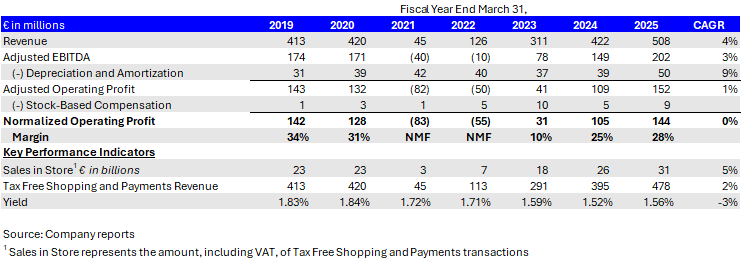
From fiscal 2019 to 2025, Global Blue’s revenue grew at a 4% compound annual rate. Two key points: First, acquisitions drove part of this growth. The Post-Purchase Solutions segment, 6% of fiscal 2025 revenue, came entirely from acquisitions made in 2021 and 2022. Excluding this segment, revenue grew at a 2% compound annual rate. Second, the U.K.’s 2021 decision to end VAT refunds reduced revenue. Excluding Post-Purchase Solutions and the U.K., revenue grew at a 4.5% compound annual rate, reflecting a realistic organic growth profile over this time period, in my opinion.
Despite revenue growth, Global Blue’s normalized operating profit remained unchanged from fiscal 2019 to 2025, with the margin dropping 6 points. This is due to unprofitable Post-Purchase Solutions revenue, higher depreciation and amortization expense, and stock-based compensation, which combined rose to 11.5% of revenue in fiscal 2025 from 7.5% in fiscal 2019.
What Is Global Blue’s Long-Term Growth Profile?
Global Blue aspires to 8-12% long-term revenue growth. When weighing the acquisition, I believe Shift4 incorporated high single-digit revenue growth for Global Blue. This can be achieved with:
Mid-single-digit or better overseas luxury spending growth;
Low single-digit contribution from new countries implementing VAT refund programs, presumably to lure wealthy tourists; and
Improved refund conversion—less than 6 in 10 eligible VAT refunds are completed.
Global Blue: Pluses And Minuses
With about 70% share, Global Blue is the far and away leader in facilitating VAT refunds globally. Outside the pandemic, overseas luxury spending growth has remained incredibly resilient, even during recessions. Global Blue has long-standing relationships and long-term contracts with the best luxury retailers in the world, and refund sharing aligns their interests. Finally, Global Blue’s data on affluent shoppers is a valuable asset for both existing and prospective customers.
Geopolitical events and pandemics disrupt international travel. While rare, the past decade has shown anything is possible. A small number of customers comprise a material percentage of Global Blue’s revenue. If one leaves, it would likely have a negative financial impact on Global Blue. Even if all the largest customers stay, pricing concessions are likely, with retailers getting a bigger slice of the refund or currency conversion fee. Finally, while Global Blue believes more countries will offer VAT refund programs, the opposite could happen—more countries could decide to end them.
Transaction Details
Shift4 raised $3.3 billion in anticipation of closing Global Blue, including:
$550 million of senior notes due 2032 with an effective interest rate of 6.9%
Approximately $800 million of Euro-denominated senior notes due 2033 with an effective interest rate of 5.7%
$1 billion of mandatory convertible (in 2028) preferred stock with a 6% coupon
$1 billion from a floating rate Term Loan, maturing in 2032, with an effective interest rate of 7%
Shift4 used the proceeds from the capital raise along with existing cash to:
Retire $450 million of senior notes due 2026
Pay the $2.0 billion equity value for the Global Blue acquisition
Retire Global Blue’s €610 million ($708 million) Term Loan

As of the close, Shift4’s net debt of $3.336 billion represented 3.7x my trailing twelve-month pro-forma EBITDA estimate for Shift4 and Global Blue of $898 million. Shift4 expects cash interest payments on its debt to be $230 million annually, including $75 million in Q1 and Q3 and $40 million in Q2 and Q4.
Shift4 is modeling $80 million of revenue synergies, which consist of:
Cross-selling Global Blue’s dynamic currency conversion, or DCC, product into Shift4’s merchant base, specifically hotels where international visitors may be more prevalent.
Converting a small portion of Global Blue’s retail customers and their $500 billion of volume onto Shift4’s end-to-end processing solution.
Why I Don’t Like The Global Blue Deal
My initial reaction to the Global Blue acquisition was unfavorable, and it remains so to this day. Here’s why:
Throwing out the playbook? Since Shift4’s IPO, I count 15 acquisitions with an average purchase price of approximately $120 million. In my opinion, these were low-risk deals that offered high potential upside relative to the price tag. Yes, it was likely that these types of deals would no longer be needle movers for Shift4 given its size, but it certainly looks to me that Shift4 decided to commit a sizable amount of capital to generate a reasonable return rather than pursuing several smaller deals with more attractive upside potential.
The end-to-end cross-sell doesn’t seem like a sure thing for Global Blue’s customer base. Most of Shift4’s acquisitions are a cheap way to add captive merchants that do not utilize the company’s end-to-end processing solution. Many merchants are smaller, and Shift4 has tools to convince them to switch. That’s not the case with Global Blue’s customers. Of the $500 billion cited as the end-to-end payment volume cross-sell opportunity, approximately 80% resides with enterprise customers. The remaining 20%, or $100 billion, sits with smaller customers who may be more likely to use Shift4. I hope I’m wrong and Shift4 can land some of Global Blue’s enterprise customers; it would certainly be a coup. But for now, I believe Shift4 faces a relatively narrow opportunity for converting Global Blue’s end-to-end processing volume opportunity.
The acquisition of Global Blue makes it less likely that Shift4 will be acquired themselves. While I never invest solely based on the hope that a company will be acquired, it was part of my thesis when I first bought Shift4 shares in 2023. The company put itself up for sale and was pursued by Fiserv and Amadeus in early 2024, but no transaction occurred. Now, with significantly more debt and less concentrated, more disparate businesses, sale talks are unlikely to resume, eliminating any acquisition premium in the company’s multiple.
Can Shift4 avoid the scarlet letter placed on complex payment companies with lots of debt? The early answer appears to be no. Global Payments, Fiserv, and Corpay—what do they have in common? They exist in their present form due to several or more acquisitions. They carry material debt. And they trade at low multiples despite attractive financials, including high single-digit organic revenue growth, healthy margins, and excellent free cash flow conversion. My fear is that Shift4 will get lumped in with this group, exerting persistent downward pressure on its multiple.
The Numbers
Before I get into my discussion, a friendly reminder that valuing stocks is challenging. Two common methods are applying a multiple to some form of earnings or using a discounted cash flow (DCF) model. Earnings can be manipulated, and their definition varies by company. The DCF model rightly values a company based on future free cash flow discounted to the present but relies on subjective assumptions. Combining both—using a DCF model cross-referenced with market-based valuation multiples—is often best. A company attractive under both approaches is likely a strong investment.
Key Assumptions
I take a conservative approach to modeling the combination of Shift4 and Global Blue over the near term. It’s important to note my EBITDA and operating profit figures exclude stock-based compensation but add back restructuring, acquisition, integration, and other non-recurring items—more on that later. Also, I contemplate no other acquisitions, including Smartpay and Worldline’s North American subsidiaries.
Processed Volume. $207 billion in 2025, below Shift4’s guidance midpoint of $210 billion. Growth slowing to 17% in 2026 and 15% in 2027, all organic.
Spread. 61.6 bps in 2025, up slightly over 2024. Falling by 1% in both 2026 (61.1 bps) and 2027 (60.7 bps).
Sales in Store. 13% growth, on a pro-forma basis, during 2025, falling to 8% in both 2026 and 2027.
Yield. 1.58%, on a pro-forma basis, during 2025, declining slightly to 1.57% in 2026 and 1.56% in 2027.
Revenue Synergies. I assume a slow ramp in revenue synergies with none during 2025, $25 million in 2026 and $65 million in 2027. I assume about 85% of the revenue synergies drop to the bottom-line.
Cost Savings. I assume no cost savings from Global Blue.
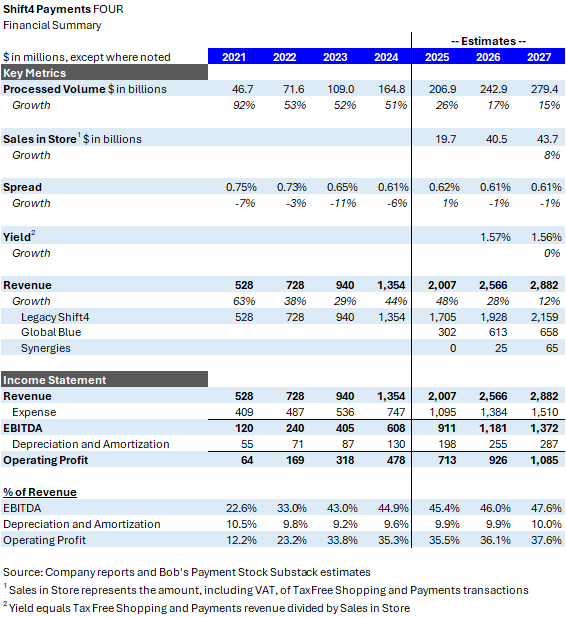
My assumptions yield a 2026 EBITDA estimate of $1.181 billion and pro-forma organic revenue growth of about 13%. Based on these numbers, Shift4 trades at a significant discount to its high-growth FinTech peers:
But…Shift4 is a serial adjuster. One of my primary concerns with Shift4 is earnings quality. Since the start of 2021 (the last 18 quarters), Shift4 has added back $223 million to its adjusted EBITDA calculation, or about 13% of the total, from restructuring, acquisition, integration, and other non-recurring items.
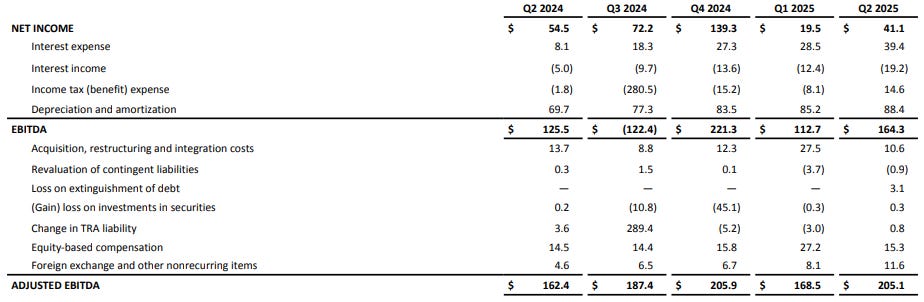
While I expect more significant restructuring, acquisition, and integration charges in the near term, starting in 2026, absent acquisitions, I assume a baseline run-rate of $75 million per year. This reduces my $1.181 billion 2026 EBITDA estimate to $1.106 billion. Still, using $1.106 billion for 2026 implies an EV-to-EBITDA multiple of 9.8x, a significant discount to Shift4’s high-growth FinTech peers.
Discounted Cash Flow Model
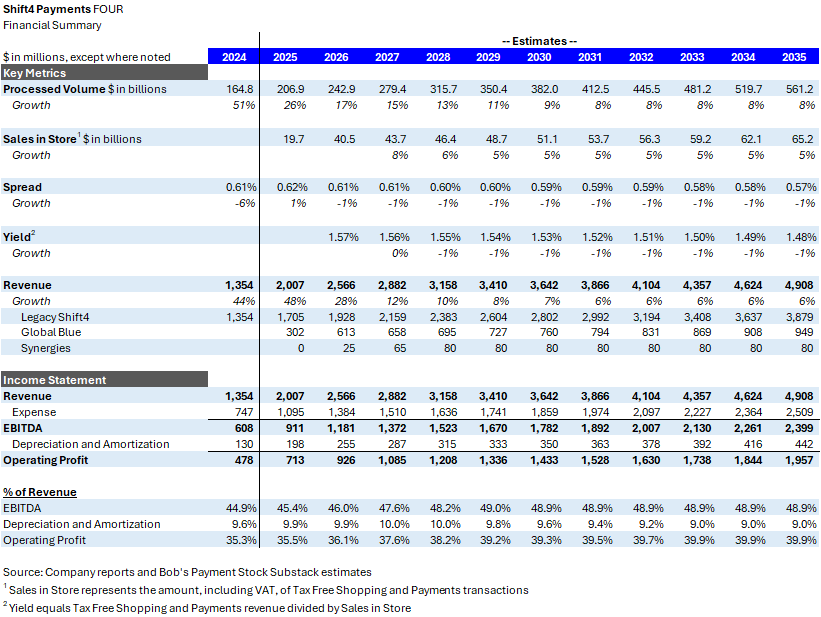
Over my 10-year forecast, I continue my conservative approach, assuming:
Processed volume growth falls to 8% by 2031 and remains at that level for the remainder of my forecast.
Spread continues to fall by 1% per year.
Legacy Shift4 revenue grows at a compound annual rate of 8.5% from 2025 through 2035.
Sales in Store growth falls to 5% by 2029 and remains there through 2035.
Yield declines 1% per year.
Standalone Global Blue revenue grows at a compound annual rate of less than 5% from 2026 through 2035.
Revenue synergies reach $80 million by 2028 but increase no further.
I assume no cost savings from Global Blue.
After reaching 48.2% by 2027 (up from 44.9% in 2024), partially reflecting favorable flow-through from revenue synergies, I assume Shift4’s EBITDA margin reaches 49% by 2029 and stays there for the remainder of my forecast period.
An additional $100 million in restructuring, acquisition, and integration charges over the next two quarters, bringing the 2025 total to $158 million. Starting in 2026, absent acquisitions, I assume a baseline run-rate of $75 million per year through 2035.
In 2026, I believe capital expenditures will represent 10.5% of revenue, reflecting a high single-digit percentage for Global Blue and a low double-digit percentage for legacy Shift4. Over my forecast period, I assume capital expenditures fall to 9% of revenue, and align with depreciation and amortization starting in 2027.
I assume a tax rate of 21%.
I assume a terminal growth rate of 3%, below nominal GDP growth (2% real growth plus 2% inflation).
To reflect the risk from Shift4’s elevated debt, increasingly complex business operations, and the discretionary nature of many spending categories the company is exposed to (restaurants, hotels, entertainment venues, and luxury goods), I use a discount rate of 10%.
This yields a fair value of $108, representing 42% upside versus the current share price of approximately $76. On my 2026 EBITDA estimate—reduced by $75 million for restructuring, acquisition and integration charges—of $1.106 billion, my fair value of $108 implies an EV-to-EBITDA multiple of about 12.7x.
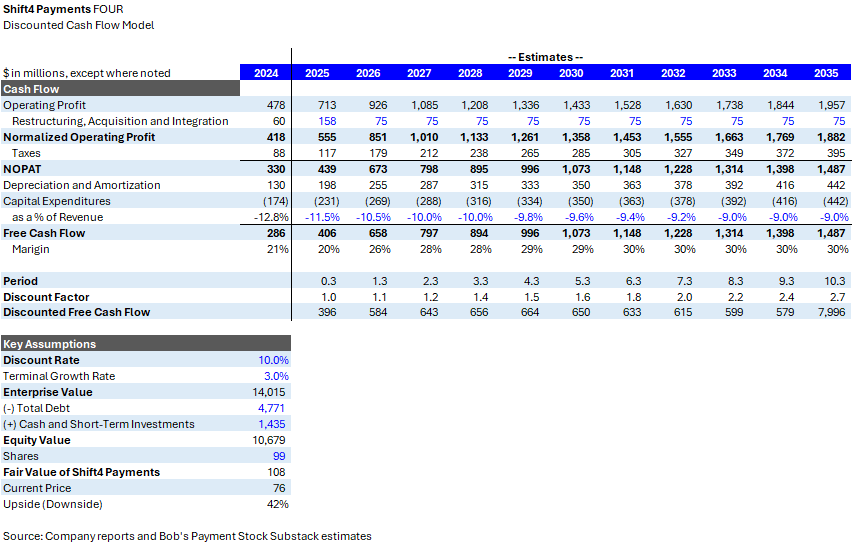
Why I believe I’m being sufficiently conservative:
An 8.5% compound annual growth rate for Shift4’s legacy revenue over my 10-year forecast period assumes only modest conversion of the end-to-end payment volume funnel outside of Global Blue.
The less than 5% growth rate for Global Blue standalone revenue assumes a significant slowdown from current levels and is comfortably below Shift4’s assumption for high single-digit growth.
I assume a bare minimum of revenue synergies from Global Blue, and nothing else. I also do not incorporate any cost savings from Global Blue.
Even though restructuring, acquisition and integration charges should presumably stop, or be exceedingly low, in the absence of acquisitions, I assume $75 million per year over my forecast period.
My Thoughts on the Stock
Despite my displeasure with the Global Blue acquisition, and my concern over complexity, which has the potential to exert persistent downward pressure on Shift4’s multiple, selling shares at these levels would be imprudent, in my opinion. That being said, I believe there are more attractive opportunities for new money purchases in payments, specifically Fiserv, which has a similarly attractive valuation but less risk than Shift4.
Disclosure: Of the names mentioned in this report, I am long Shift4 Payments, Global Payments and Fiserv. This report is for informational purposes only and is not a recommendation to buy or sell any stock. Finally, while I rely on the information in this report to guide my investment decisions, you should not, because I cannot guarantee its accuracy.
My calculation of enterprise value is $2.594 billion, while Shift4 has consistently stated an enterprise value of approximately $2.5 billion
Looking at your forecast now in hindsight, your FCF estimates are far higher than what they'll achieve. What do you think its worth now starting off base of $450m in FCF and growth materially lower (HSD organic)?
Great Article — Shift 4 is a really interesting one. I also just published a deep dive on the company if anyone wants another perspective on it! https://substack.com/@stonemountainresearch/note/p-189720240?r=1ml5j6&utm_source=notes-share-action&utm_medium=web