

Investment Brief
For most of its existence, Toast has focused on doing one thing extremely well: building a comprehensive technology platform for independent U.S. restaurants. With its sales force of local culinary experts, Toast’s modern platform rapidly displaced standalone terminals and legacy point-of-sale systems at restaurants in downtowns and on main streets across the U.S., capturing a high-teens percentage of total locations in just over a decade.
From an investor’s perspective, Toast is simple to understand. The company has refrained from disruptive acquisitions and rushed expansion, driving forward a best-in-class organic growth story, consistently delivering against a couple key operating metrics, including locations, gross payment volume (GPV) and annualized recurring revenue (ARR).
After a period of losses, Toast is now delivering profitable growth. For 2025, Toast expects to deliver adjusted EBITDA of $575 million at the midpoint of its guidance, or 32% of the company’s recurring gross profit, up from an adjusted EBITDA loss of $118 million in 2022. Toast believes it will exceed an adjusted EBITDA margin of 40% over the long-term.
The company’s disciplined approach sets the stage for successful expansion into international markets and adjacent categories. Together, new international markets1 and U.S. food and beverage stores add 500,000 locations and nearly $1 trillion in sales to the company’s total addressable market. Toast is likely to succeed internationally for two reasons. First, competition is less intense, though increasing. Second, the integration of payments and software is less developed. On its most recent earnings call, Toast announced it surpassed 10,000 live locations across its new customer segments2 and expects to achieve $100 million of ARR by the end of 2025.
My thoughts on the stock. Toast is a uniquely strong business, but its premium valuation reflects this. Even based on what I believe are aggressive assumptions, Toast is still slightly overvalued. Below are highlights:
Where could I be wrong? My model assumes continued significant share gains in U.S. restaurants (nearly 40% by 2034) and strong success in the company’s initial international markets and U.S. food and beverage retail (market share in the high teens by 2034). It excludes additional international market or category expansion. For Toast to be attractively valued, in my opinion, would require all my aggressive assumptions about current market opportunities, plus successful entry into unidentified markets, all while maintaining a high level of profitability. I am not willing to take this leap. All else equal, I would be interested in buying Toast shares at-or-below the mid-$30 range.
Investment Highlights
Purpose-built for restaurants. Unlike competitors, which have focused on selling horizontal (or less robust vertical) solutions into multiple categories, geographies and customer sizes, Toast serves independent restaurants in the U.S. with a specialized and comprehensive technology platform. The company’s obsession with the “thousand little things” that make Toast a great tool for restaurants sets the company apart, in my view. Compared to even its most successful competitors, Toast’s growth has been far superior. Even though competitors are strengthening their restaurant offerings, it is unlikely any will ever match Toast’s intensity of focus on this vertical.
Unique go-to-market. Toast relies on individuals with deep knowledge of local restaurant communities to sell its solutions. The company’s sales force engages in active dialogue with customers to identify unmet needs, creating a pipeline of new innovations Toast can develop and monetize.
Toast’s flywheel effect suggests meaningfully higher market share over time. The most difficult sale for Toast in a market is its first. After that, the company’s flywheel effect takes over. As Toast likes to say, restaurant people talk. And when Toast enters the market, restauranteurs take notice. Social proof generates referrals, creating a virtuous cycle of increased sales productivity and accelerating location growth. In fact, in its most penetrated markets, Toast’s growth is the fastest, suggesting the company’s market share ceiling is high.
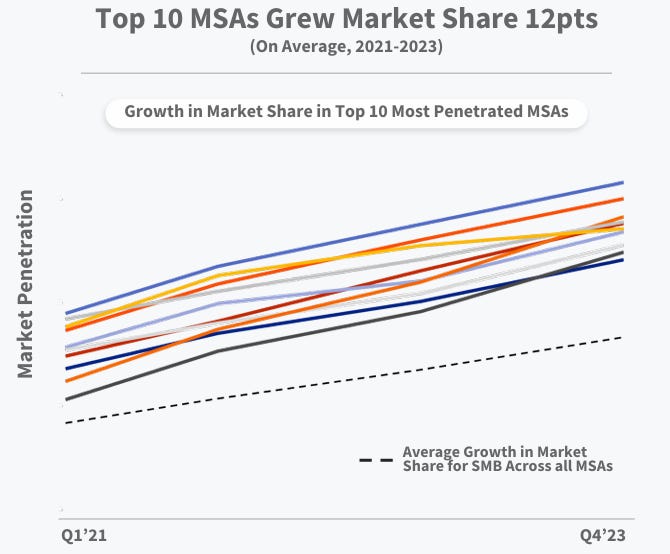
Source: Toast Investor Day Presentation, 2024
The restaurant industry may be less discretionary than the market believes. Even though there is a perception that consumer spending at restaurants is discretionary, outside of the pandemic year of 2020, only one year in the past 23 has seen a decline in sales at food and drinking places, as reported by the U.S. Census Bureau. Additionally, the compound annual growth rate in retail sales at food and drinking places has been 5.7% over the past 23 years, with the category increasing its share of retail sales by 4% over that time frame.
Ample financial flexibility. At the end of its most recent quarter, Toast had $1.7 billion in cash and marketable securities against no debt, providing the company with flexibility to pursue larger strategic acquisitions, repurchase shares to offset dilution, or make more meaningful repurchases if shares fall to an attractive level.
Risks
Strengthening competitors. The restaurant point-of-sale market is crowded and highly competitive. Major players have made changes to strengthen their positions:
Square introduced new hardware, including a slimmed-down handheld device, and invested in distribution through field sales and partnerships. Recent results show Square’s food and beverage volume grew 15% during Q2.
Global Payments re-launched its Genius platform, replacing several legacy restaurant point-of-sale systems, and refined its sales motion and compensation structure.
NCR Voyix is actively transitioning restaurants from its legacy on-premises systems to the cloud-based Voyix Commerce Platform (VCP).
Clover by Fiserv and Shift4 Payments’ SkyTab are strong competitors in U.S. restaurants, leveraging advanced technology and robust distribution, particularly for Fiserv’s Clover operating platform.
More limited runway in its core market. Toast claims a mid-teens percentage of U.S. restaurant locations, but its market share is higher among independent restaurants, limiting expansion in this key segment. Independent restaurants are more attractive despite lower sales volume, as their net take rate is higher than that of enterprise customers. In 2024, the U.S. had about 721,000 food and drink establishments, per the Census Bureau. Independent operators, typically with one or few locations, represent roughly 483,000, or two-thirds of the total. While Toast is gaining traction in the enterprise (or chain) segment, most of its locations are independent restaurants. At the end of 2024, I estimate Toast held about one-quarter of independent U.S. restaurant locations. Although Toast’s share will likely increase, there is a question as to how high it can go.
The company's expansion into new customer segments may be costlier and less successful than expected. Toast attributes its success among independent U.S. restaurants to its sales expertise and platform's breadth and depth, built over a decade. While it believes this will translate to international markets, success is not guaranteed. Additionally, food and beverage retailers have unique needs, such as advanced inventory management, which may require ongoing investments from Toast.
Valuation
Key assumptions underlying my ten-year forecast are:
For locations, I estimate:
U.S. restaurant locations grow 1.8% through 2034, similar to their long-term average, and Toast’s share increases to 39%, implying 339,000 Toast locations in 2034, up from about 129,000 locations, or an 18% share in 2024.
Similarly, I expect U.S. food and beverage retail locations grow 1.8% through 2034 with Toast’s share increasing to more than 17%, implying about 45,000 Toast locations by 2034.
I assume faster growth in international locations, growing 2.5% through 2034, with Toast’s share reaching about 20% or 72,000 locations in 2034.
My GPV estimate assumes relatively constant GPV per location as larger GPV locations in food and beverage retail and U.S. enterprise restaurants are offset by lower GPV locations in international markets and a move down market by Toast among independent U.S. restaurants.
I assume an upward bias to Toast’s Payments net take rate as its increased scale facilitates savings from its processing and network partners. I do not assume material increases in the processing rate for Toast’s customers.
Non-GAAP subscription gross profit. I expect a mid-single-digit increase in Toast’s subscription revenue per average location, driven by product attach and modest price increases, and an increase in non-GAAP subscription gross profit to more than 81% in 2034, up from 76.5% in 2024.
Cash operating expense3. I model Toast’s cash operating expense falling to 40% of recurring gross profit by 2034, down from 52% in 2025. I estimate stock-based compensation plus payroll taxes to fall to 8% of recurring gross profit by 2034.
Taxes. I assume a long-term effective tax rate of 23.5% for Toast.
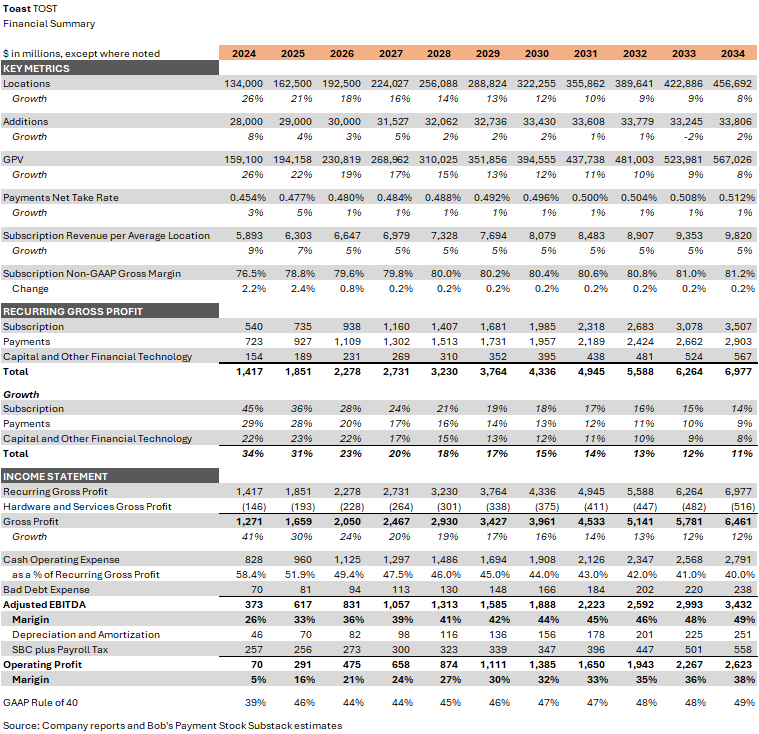
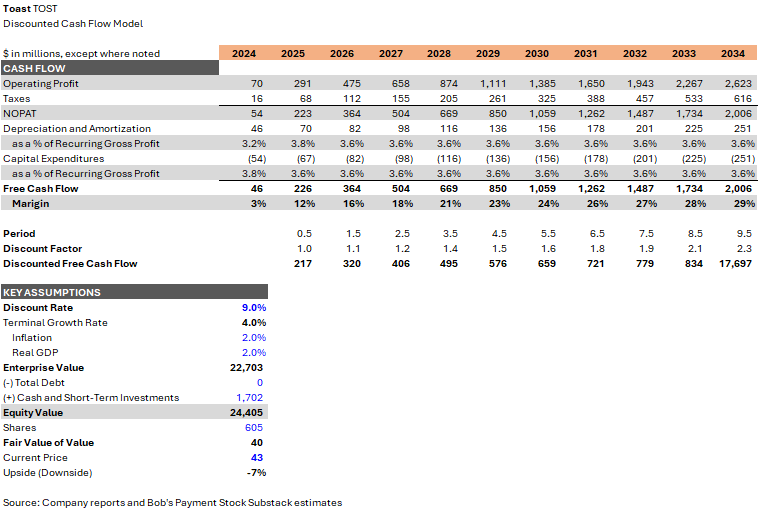
My fair value estimate for Toast is $40 and implies an EV-to-adjusted EBITDA multiple of more than 27x, based on my 2026 estimates. If I exclude stock-based compensation and related payroll taxes from my 2026 adjusted EBITDA estimate, it yields an EV-to-EBITDA multiple for Toast of about 41x.
To neutralize the impact of ongoing dilution from Toast’s stock-based compensation program, I calculate free cash flow as GAAP net operating profit after taxes (NOPAT) plus depreciation and amortization minus capital expenditures. On this basis, Toast generates more than $2 billion of free cash flow by 2034, implying a 29% margin on recurring gross profit. I use a 9% discount rate for Toast, which balances the company’s recurring SaaS-based fees and Payments gross profit with uncertainty regarding the company’s expansion into international markets and U.S. food and beverage retailers.
Company Overview
Toast designs and sells modular technology platforms for restaurants and food and beverage retailers, including proprietary hardware, cloud-based software, payment processing, and third-party applications. These platforms support front, middle, and back-of-house operations such as point-of-sale, reservations, marketing, ordering, kitchen operations, inventory and vendor management, scheduling, payroll, and analytics.
A Brief History of Toast
Toast was founded in 2011 by Steve Fredette, Aman Narang and Jonathon Grimm, former employees at Endeca, a software company. Their initial vision was a mobile app for restaurant reservations and payments. Struggling to integrate with legacy systems, they pivoted to reimagine the restaurant point-of-sale system. In 2013, Toast launched its modern cloud-based platform, combining proprietary hardware, software, and payment processing, later expanding features through internal development and acquisitions.
The company held its initial public offering in September 2021, during the pandemic. After reaching an intraday all-time high of nearly $70 per share in November 2021, the stock price fell to $13 two years later as the company struggled to achieve profitability and the restaurant industry faced macro concerns from rising interest rates.
In early 2024, Aman Narang, co-founder and COO of Toast, became CEO, replacing Chris Comparato, who served since 2015. In February 2024, Toast announced a restructuring, cutting 10% of its workforce, saving about $100 million annually.
After achieving success with independent U.S. restaurants, Toast is expanding into a small number of international markets and U.S. enterprise restaurants and food and beverage retailers. The company recently surpassed 10,000 locations for these new segments and expects to reach $100 million in ARR by the end of 2025. Over time, Toast plans expansion into additional international markets and adjacent categories.
Key Products and Services
I separate Toast’s key product and services into the following categories:
Hardware. Toast offers a fixed point-of-sale terminal, a handheld device for servers that allows them to enter orders and accept payments at the table, and kiosks, which enable customers to place orders unassisted by the restaurant’s employees or wait staff. The company’s kitchen display system, or KDS, streamlines operations for chefs and kitchen staff.
Restaurant Operations. Toast offers software modules enabling restaurant operators to manage menus and view consolidated analytics for multiple locations on a single dashboard. Toast Benchmarking provides a comprehensive view of the competitive landscape for a local restaurant market.
Marketing and Ordering. The company’s marketing solutions include email and text message advertising, loyalty programs, gift cards, and reservation systems. Toast offers online orders for restaurants and a solution that consolidates ordering and delivery across it first-party product and third-party apps.
Digital Presence. Toast provides tools for restaurants to design and build their own websites and branded apps. Local by Toast, a customer-facing mobile app, drives traffic to Toast restaurants in local communities.
Human Capital. The company’s team management suite offers employee scheduling and payroll, including a pay card for employees to receive wages. According to Toast, approximately one-quarter of customers utilize these features.
Back-Office. Toast's back-office solutions help restaurants save money and track expenses with tools like accounts payable automation, inventory management, and cost analysis of ingredients and menu items. All features integrate with third-party accounting software for a comprehensive view of financial performance.
Financial Technology. Toast provides payment processing and loans through Toast Capital. For payments, Toast sets a fixed rate, with its net take rate varying based on the mix of credit and debit card payment volume. Toast offers short-term loans to customers, repaid by taking a percentage of daily processing volume until fully repaid. Toast has two loan models: one where it shares repayment risk with a banking partner, earning a mid-teens revenue yield on origination volume, and a newer model where Toast sells the loan to a third party, eliminating credit risk but reducing the yield to a mid-to-high single-digit percentage.
Go-to-Market
Toast relies on experts in local restaurant communities to sell its solutions. It has separate sales teams for acquiring new customers and upselling existing ones with additional software modules. The company is launching a new sales force to target the U.S. food and beverage retail market. Toast uses data and analytics to refine its sales process, logging data from every customer pitch and sales rep interview.
U.S. Restaurant Market
The U.S. restaurant market is an interesting one to analyze. Although several entities provide high-quality data, their results vary slightly. Nonetheless, I am confident in the market's approximate size and attributes. For this analysis, I rely on thorough but less timely and conservative government data.
Over the past ten years, the number of U.S. food services and drinking places establishments grew at a compound annual rate of 1.9%, reaching approximately 721,000 in 2024.
Over the past ten years, retail sales for U.S. food services and drinking places grew at a compound annual rate of 7.1%, reaching approximately $1.15 trillion during 2024. Over the last 23 years, retail sales at food and drinking places grew at a compound annual rate of 5.7%.
From The Number of Firms and Establishments, Employment, Annual Payroll, and Receipts by State, Industry, and Enterprise Employment Size: 2022 report, we know the following about U.S. food services and drinking places:
Independent vs. Chain. Based on available data, approximately 483,000 independent restaurants operated in the U.S. at the end of 2024, comprising about two-thirds of total locations. Independent restaurants typically have one or a few locations, while chain restaurants, which have several to several thousand locations, accounted for the remaining 238,000 locations.
Toast has historically targeted independent restaurants but has proven its ability to win in the enterprise segment with recently wins of Applebee’s, Firehouse Subs and Topgolf, among others.
Financial Review
Below is an evaluation of Toast using my Investing Checklist.

Disclosure
Toast provides clear disclosure, consistently reporting location numbers, GPV, Payments gross profit, enabling calculation of net take rate, ARR, and contributions from other Financial Technology products, mainly Toast Capital loans. Toast selectively discloses new customer segment data, but more consistent reporting would be helpful as these segments grow. The company reports adjusted EBITDA, a non-GAAP profitability measure, excluding non-recurring items, acquisition-related costs, and stock-based compensation.
Growth
From 2019 through 2024, locations, GPV, ARR, and recurring gross profit grew at compound annual rates of 38%, 49%, 55% and 65%, respectively.
Toast demonstrates highly favorable growth characteristics:
No single customer accounts for a significant portion of recurring gross profit due to the large number of independent restaurants served
Growth is driven mainly by increased locations and product adoption, with minimal pricing impact
Going forward, I expect Toast’s growth algorithm to remain consistent, driven primarily by location growth, a mid-single-digit increase in SaaS ARPU, resulting more from product attach than pricing, and an upward bias to the company’s Payments net take rate as its increased scale facilitates savings from its processing and network partners.
Toast has benefitted from tailwinds to growth during the past twelve months that are likely to moderate in the second half of 2025. They include improved conversion of subscription ARR to revenue, which resulted in stronger subscription gross profit growth, and about a 4 bps increase in the Payments net take rate from a pricing increase, cost optimization efforts and a new surcharging product.
Profitability
Toast is successfully transitioning to profitability on both non-GAAP and GAAP bases. On a GAAP basis, I expect an operating profit exceeding $290 million in 2025, a significant improvement from a $374 million loss in 2022. However, stock-based compensation remains high, projected at 14% of recurring gross profit in 2025, declining to a low double-digit rate over the medium term.
Free Cash Flow
Over the past year, Toast generated $508 million in free cash flow, nearly matching its adjusted EBITDA. Excluding $253 million in stock-based compensation and payroll taxes, Toast’s free cash flow of $255 million reflects a 15% margin on recurring gross profit. As Toast becomes more profitable on a GAAP basis, its free cash flow will be negatively impacted due to cash tax payments.
Financial Health
As of June 30, 2025, Toast had $1.7 billion in cash and marketable securities and no debt.
Returns
In 2025, I estimate Toast will generate a return on average tangible assets of over 20%, reflecting the appeal of its SaaS-based business model.
Capital Allocation
Toast retains most of its excess capital as cash and marketable securities. The company pays no dividends, makes limited share repurchases ($54 million in 2024), and has spent just over $100 million on acquisitions since 2019.
Disclosure: I do not hold a position in Toast. Of the stocks mentioned in this report, I am long Global Payments, Shift4 Payments and Fiserv. This report is for informational purposes only and is not a recommendation to buy or sell any stock. Finally, while I rely on the information in this report to guide my investment decisions, you should not, because I cannot guarantee its accuracy.
Canada, the United Kingdom and Ireland
International markets and enterprise restaurants and food and beverage retailers in the U.S.
Operating expense less stock-based compensation and related payroll taxes, depreciation and amortization, and bad debt expense
This is an excellent write up and analysis!!
Few comments:
• Toast’s current US TAM is probably smaller than census bureau as toasts sweet spot is the mid range of hospitality, as in not small kiosks or food trucks but sit down or casual dining restaurants. The lower end is better served by square/clover. This means they’re closer to saturation.
• Attrition in restaurants benefits them as Toast predominantly wins these, so long term the TAM can expand.
• Valuation justification is built on new expansion: retail, intl, enterprise.
• Toasts clear leadership merits a large valuation premium imo as the larger scale the better unit economics they’ll achieve long term.
• New initiatives like generating demand could add a lot of value if they can pull it off.